Pinhole Photos
May 12th, 2012April 29th was World Wide Pinhole Photography Day - a great event that keeps me shooting iwth a pinhole camera (if only one day per year.) This year I took to the field with the Peinhol Body Cap for the Pentax 6x7 and with my trusty converted Kinoflex TLR. It has taken some time to scan all of the film, and I can’t say that I am really thrilled with anything, but what the heck, it’s relaxing to take exposures that are measured by the seconds as opposed to hundredths of a second…
So - here is a shot with the Pentax 6x7 and Pinhole body cap. This is labeled as an f244 pinhole. I was captivated by the fading dogwoods at the edges of forest clearings, so that is the subject of many of these shots (click on any shot for a larger file):
And here is a dogwood shot with the Kinoflex:
The Pentax body cap is (I think) a laser cut pinhole. The Kinoflex was drilled, and even to the unaided eye irregularities in the roundness of the pinhole can be seen. From imperical tess with exposures, I reckon the Kinoflex to be around f180.
Finally - a few small trees in a clearing. At this point I got distracted by a snake, and stopped with the pinholes and started shooting macros:
More images will be in the Photoblog as I process them.
Snake in the Grass
April 30th, 2012Yesterday was World Pinhole Photography Day and I was in the Allegan Forest taking pinhole photos, of course. NO word on how those have come out - still waiting for the color film to come back from the lab, and just getting started with scanning the B&W… But, standing in a clearing I looked down and spotted this lovely golden colored Hognose snake, resting in the warm afternoon sun.
I didn’t thinkt hat an 8 second exposure would do the trick, so I switched up to the Pentax K-5 and A* 200 macro lens. The snake was small - just under two feet long - and it gave a nice show as it slinked away. So - tongue up, grass blade up:
Tongue down, grass blade down:
Click on the images for a larger file.
The Shady Spot - Revisited
April 15th, 2012Here’s a re-work of a shot I took in 2008 and posted here then:
Click on the image for a larger file.
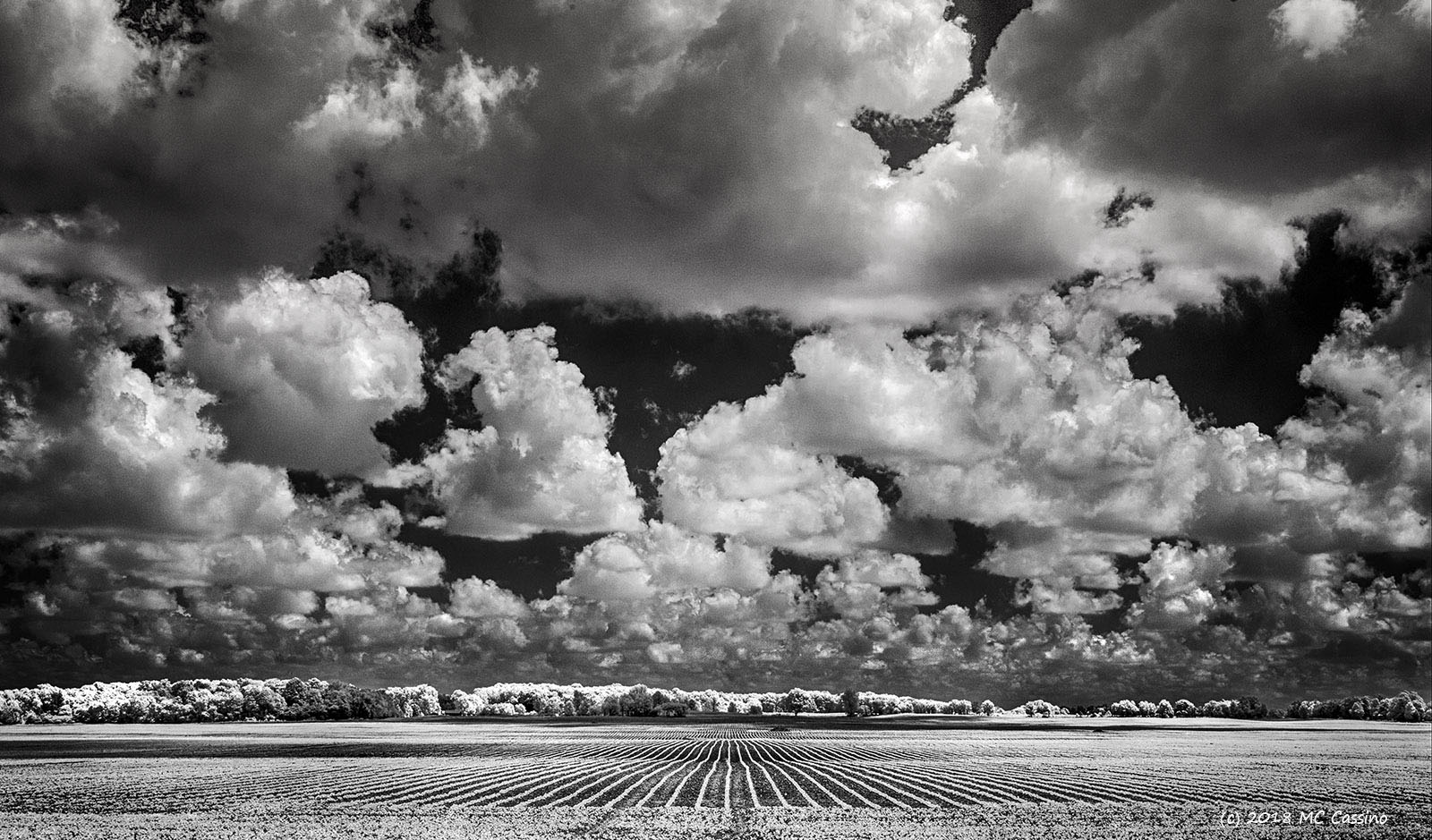
The shot was one of the few successful images I had managed to get using Rollie IR 400, but unfortunately there was just not the needed tonal separation between the foliage in the trees and foreground scrub and the clouds and grassy plain. In this re-work I rescanned the negative, ran it through Photomatix tone mapping to better balance the shadows and highlights, and then went through extensive hand toning and local dodging and burning. I think it came out pretty nice…
Unfortunately, I scanned at a low resolution and was hours into working with it before I realized that it was only about half the size of a standard 35mm scan… Hmmm - maybe that is why is came out so nice this time? Well, it makes for a very nice small print…
Taken with a Pentax LX, FA 20-35mm f4 zoom, Rollie IR 400, HC110 Dil H and Hoya R72 IR filter.
Jazz the Cat
April 11th, 2012A few days ago I caught my cat Jazz sitting in the sun and took a quick snapshot or two. Here’s the best of the bunch - click on the image for a larger view.
I like it because it has that classic film look to it - I’m not sure how it would have turned out as a digital exposure. With the bright light on the cat, the background is darkened and that also gives the shot of a bit of a noir feel, at least to my eye.
Jazz is indifferent to the photo - well, few among us like their own image.
Made with a Pentax LX and Kiron 105mm f2.8 macro lens on Fuji Neopan 400, rated at 400. Developed in D76 1+1.
Colors of Spring
April 8th, 2012Last weekend I visited the Devil’s Soupbowl, a glacial kettle hole located in the Yankee Springs state recreation area just north of Kalamazoo. It’s a nice place in that it affords an opportunity to look down into the foliage of the trees growing 60 feet or so below.
It was a dim overcast day and I found myself trying to capture the colors of the trees in their early foliage and flowers. Here are a couple of photo - both taken with the Pentax 6x7 and SMC Takumar 170mm f2.8 lens on Fuji Reala. Click for a larger view.
Note: I changed the above image on 4/9. You can see the original, less sharp one here
Images of Early Spring
April 6th, 2012A Few Holga Shots - March 2012
March 30th, 2012Here are a some Holga shots from the last few weeks.
First - I’ve been experimenting with Ilford SFX in a Holga. A 52mm deep red filter fits nicely on the front of the plastic lens (you have to push hard, but it will fit on and stay there). Here’s a little country church taken with this setup:

Solar flare activity was quite high when I took that shot and you can see the aurora in the sky over the church even the the midday sunlight… Or maybe the Holga was leaking light. Well, more likely that…
Here is an SFX shot of barren spring woods - not much infrared effect but there was not much greenery out yet:

SFX is a pretty tame infrared film, but it is fast enough to be used in a hand held Holga, even with a deep red filter. (I developed the SFX in HC-110 Dil B and pushed these exposures by one stop.) I’m hoping for some more pronounced IR effects once the green foliage is out.
And here is a double exposure of a snowmobile trail, looking to the east, looking to the west …. Classic Pan 200 developed in HC-110 Dil H.

Lastly , a squirt gun found out in the woods, same place where I found a bunch of dead a few years ago:

Early Spring Wildflowers
March 16th, 2012The winter that wasn’t has transformed to the exceptionally early spring. Crocuses in my yard are out in force - I had hoped to get an “Ah Spring” shot of a honey bee in the flowers, but so far I have not seen any honey bees this spring. So instead I went down to Cass County, Michigan to see if the hepatica had emerged yet.
It’s very early, but to my surprise there were a few hepatica out. Harbinger of spring was also out in force while skunk cabbage shoots and flowers (which smell like rotten flesh) were just starting to poke out of the ground.
A few photos - first off, Harbinger of Spring (click for a larger image):
And then some blue hepatica and white hepatica:
Effluence
March 12th, 2012Melting Crystals
March 4th, 2012“I’m melting! Melting!
Oh, what a world! What a world!”
– Wicked Witch of the West
In a winter as warm as this, every snow is like the first snow. Wet flakes land on warm ground, melting on the sidewalks and streets but sticking on the grass. Last night’s snowfall proved to be no exception, as the temperature outside hovered just a few degrees below freezing… And inside the garage where I shoot snow crystals, the residue of the last few warm days kept the temperature right at the freezing point.
Well, at least it was snowing… I tried a few shots and the snow crystals quickly melted, before I could take any photos. Back in December, 2009, I took an usual shot of a snow crystal just as it melted away - or maybe it was a photo of a drop of water, just as it emerged from a crystal. I don’t remember… Well, with all these melting crystals, maybe that is something to try again…
So - here is one of the first shots of the evening - a rather nice stellar dendrite that had already begun to melt when I snapped the first image of it. Here’s the first shot, where the structure is still more or less intact -
(With all images - click for a larger view.)
Here’s a shot about 45 seconds later - the last wafer thin remnant of the crystal floats on (or presses into) the drop of water, which is the melted remain of the rest of the crystal…
Well, that’s interesting. I tried some more… Here the lingering remnants of a crystal’s heart twinkle with color. It was a large dendrite that melted before I ever got the glass plate beneath the lens. I speculate the some sort of partial dark field effect accounts for the colors.
Maybe the same thing happened with this shot -
There was no opportunity to tweak the lighting for these shots - in a manner of seconds the crystals melted away to nothing. Here is another crystal that I was able to capture just as it was starting to melt - the lighting is so dead-on that it looks virtually like a B&W shot:
The crystal was not well formed, and even in the first shot it was melting in the upper right. About half a minute later, it looked like this -
Finally - the bones of two crystals that melted together, floating on their co-joined watery remains:
One Lone Crystal... 2012
January 16th, 2012This winter is turning out to be disappointing. We’ve had day after day of warm temperature, often barely dropping below freezing even in the evenings. What little snow we have gotten has been sloppy an d mixed with rain.
Last weekend we finally had a hard snow and a true blast of cold weather. While the detached garage in which I take these snow crystal photos had cooled down a bit, it still took till the next morning to finally drop below freezing inside the structure - even though it was well below freezing outside.
And so on Saturday morning I set up the camera and managed to get one, just one, snow crystal photo. The snow stopped just as I set up the rig and prepared to start photographing. Here’s the one photo I did get - click for larger version.
And here we are - another warm day and rain on the way. Maybe more crystals will come soon…
Snow Crystals With Classifications
December 14th, 2011Note: This post originally appeared in the Story of Snow’s blog - www.storyofsnow.com - on February 17, 2010. Since many these photos have not appeared here before, I’m reposting it here in Calarti.
And besides - it’s 55F and raining on this particular December evening, so no snow crystal photos in the near future this winter!
If you are interested in the classification system, checkout Jon Nelson’s original post on the subject which can be found here.
February 17, 2010:
I found Jon’s post regarding the Magono-Lee Snow Crystal classification system to be quite interesting. Here are some more shots from Monday night - I’ll see if I can classify them… something tells me that will be more difficult than it sounds.
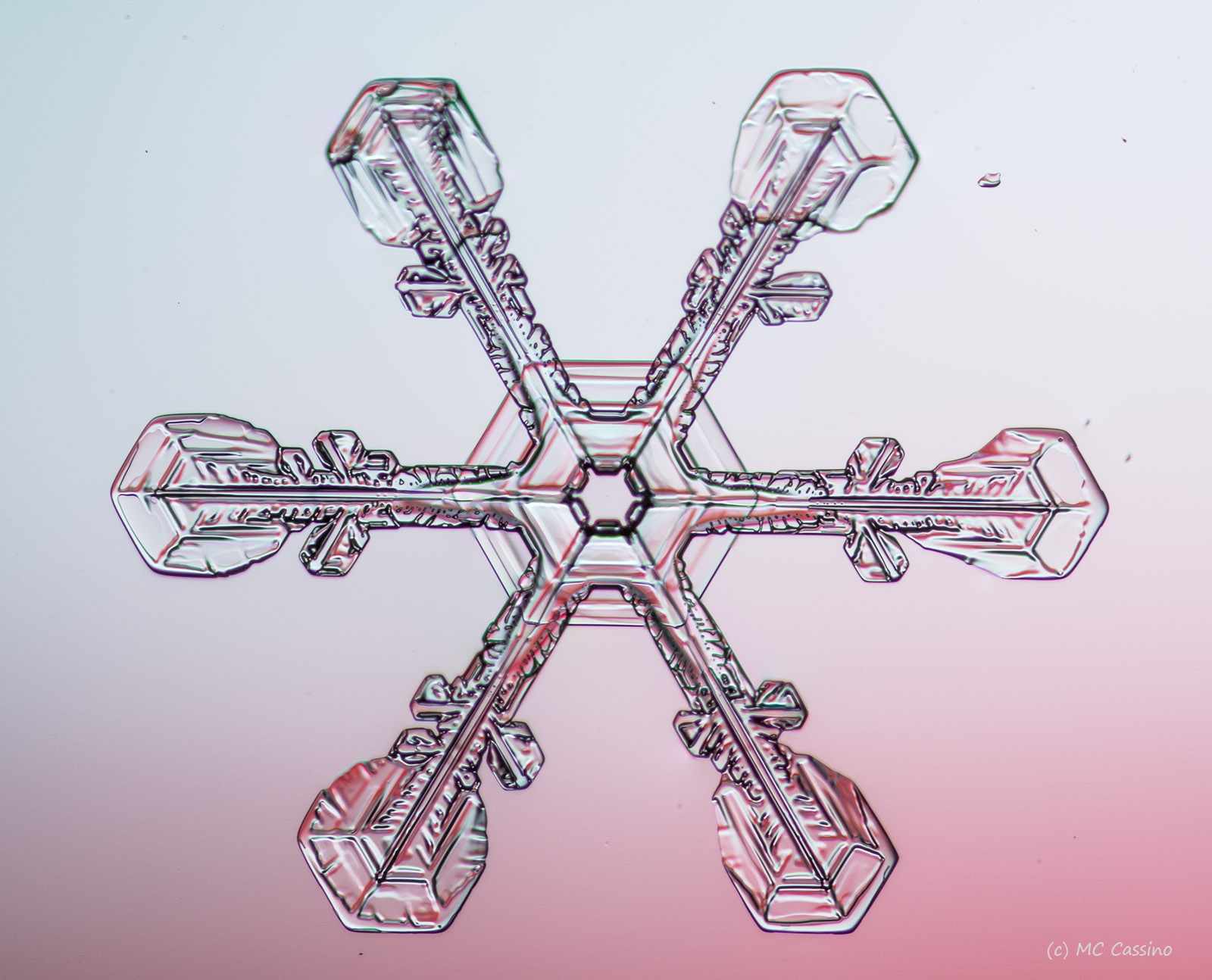
Let’s start with something simple. My first guess is that the two crystals that follow would be classified as P2d - Dendrite with Sector-like ends:

It looks like that crystal bumped into a couple of simple plates along the way, and they are stuck to it in the lower right quadrant.
The one below has one spot of rime on it - which I assume is not enough to knock it into the rimey category, so it too is a P2d:

This one is similar in general form to the one above, but has a bit of rime spotting it up. I guess it would fall under rimed stellar R1d under Magono-Lee’s system. Personally, I think it would make more sense to have rime as a qualifier of the basic shape, so if I was cooking up a classification scheme I’d call this a Dendrite with Sector-like ends with moderate rime. Maybe P2d-r2.

The next one is a 12 branched crystal without rime, so it is either a P4a (broad branched with 12 branches) or a P4b (dendrite with 12 branches.) Personally, I’d call it a 12 branched variant of the P2d formation, which we just saw above. Maybe P2d-2x? Well - under the existing system it is either a P4a or P4b…

You may have noticed what looks like a sectored plate emerging from one arm at about the 8 o’clock position - that appears to be a growth at the end of that arm.
OK - let’s get back to something simple. I think the following are all ordinary dendrites - P1e.
This first one has a ‘crack’ in the center plate - something I’ve seen several times. I’m not sure what causes it.


And I’ll close out with three rimey subjects, the first two would be R1d - Rimed Stellar and, I think, the last one would be R2b - Densely Rimed Stellar. Though one might think it was a densely rimed fernlike stellar dendrite - maybe P1f-r3, eh?


Magono-Lee is an interesting classification system. I don’t understand exactly why it places such an emphasis on rime at the expense of the core structure of the crystal. It seems to me that rime is an incidental condition independent of the core structure of the crystal. Classifying rimey crystals as a distinct group is sort of like lumping all molting birds into a distinct group. But just as Nietzsche observed that histories reveal almost as much about the historians who wote them as about actual past events, I’d speculate that classification systems tell us a bit about the people who developed them as well as the subjects being classified. Maybe rime was important to Magono or Lee…